


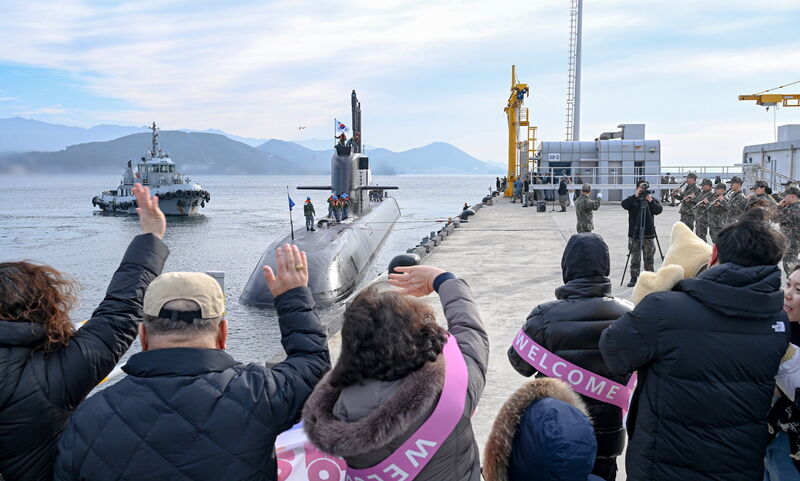
 The ROK Navy submarine An Mu (KSS-III, 3,000 tons), the first Dosan Ahn Chang-ho–class submarine designed and built with indigenous Korean defense technology to take part in an overseas exercise, enters Jinhae Naval Base on December 30 following the successful completion of the Silent Shark 2025 combined U.S.–ROK anti-submarine warfare exercise, welcomed by sailors and military families. On December 30, the ROK Navy held a welcoming ceremony at Jinhae Naval Base, hosted by Rear Adm. Kim Tae-hoon, Acting Commander of the Submarine Force. Sailors from the Submarine Command and family members of the An Mu crew attended the event, celebrating the submarine’s safe return and successful completion of its first overseas mission.
An Mu departed Jinhae in early November and arrived in Guam on November 17. Over the course of approximately one month in waters near Guam, the submarine took part in a series of high-intensity combined drills, including submarine tracking and attack training, free-play engagements, and airborne ASW operations. According to the ROK Navy, the exercises significantly enhanced combined ASW operational capability and interoperability between the two navies.
“This deployment represents a historic moment in which the Dosan Ahn Chang-ho–class submarine stepped onto the global stage,” said Col. Ahn Geon-young, commanding officer of An Mu. “As a member of the submarine force, I feel great pride, and I am deeply grateful to our crew for accomplishing this demanding mission.”
For the commanding officer, the mission carried considerable responsibility. An Mu conducted the first long-duration, long-range overseas deployment by a 3,000-ton Korean submarine, including operations in tropical waters.
“The preparation period was the most challenging time for me as a commander,” Col. Ahn said. “However, the latest-generation indigenous submarine demonstrated outstanding reliability, excellent submerged performance, cooling efficiency, and operational flexibility throughout every phase of the transit and training. What I worried about most ultimately became the most rewarding memory.”
The submarine completed a round-trip voyage of more than 7,000 kilometers between Jinhae and Guam without a single equipment failure, validating the reliability of Korea’s domestically designed and built submarine technology. Operations were also conducted in high-temperature waters, where surface sea temperatures approached 30 degrees Celsius, further proving the platform’s endurance.
During combined ASW operations, An Mu’s advanced sonar sensors, combat management system, and low acoustic signature played a key role in detecting and tracking U.S. Navy submarines. According to the ROK Navy, the crew’s rapid and accurate problem-solving demonstrated their ability to conduct ASW missions in open-ocean environments. Following the exercise, a U.S. submarine commander reportedly noted that “detecting and tracking An Mu during the training period was extremely difficult,” underscoring the platform’s stealth and operational effectiveness.
An Mu also showcased the advantages of its air-independent propulsion (AIP) system, which enabled extended submerged operations and longer snorkeling intervals, even in tropical conditions. Compared with earlier Korean submarines, the KSS-III class features a modernized combat system, expanded weapon and sensor capabilities, and significantly improved stealth.
Crew habitability was another highlighted strength. The submarine’s multi-deck internal layout provides dedicated personal spaces and ample shared storage areas, improving living conditions and helping reduce combat fatigue during long deployments.
In a further sign of growing international interest, the exercise marked the first time a Canadian Navy representative joined training aboard a Dosan Ahn Chang-ho–class submarine. During the embarkation period, the Canadian senior enlisted submarine specialist observed Korean submarine operations firsthand, including system integration, crew working conditions, and equipment reliability. Col. Ahn noted that the Canadian officer’s serious approach to training and active engagement with the Korean crew left a strong impression.
The ROK Navy assessed the deployment as a clear demonstration of the long-range endurance and tropical-water operability of Korea’s 3,000-ton indigenous submarines, adding that it plans to continue expanding opportunities to showcase the nation’s undersea capabilities through international exercises and cooperation.
K-DEFENSE NEWS | Strategic Analysis Desk
#KSSIII #AnMu #ROKNavy #SilentShark2025 #KoreanSubmarine #USROKAlliance #CombinedExercises #Interoperability #AlliedNavies #GlobalDeployment #UnderseaWarfare #AntiSubmarineWarfare #ASW #SubmarineOperations
#StealthSubmarine #AirIndependentPropulsion #AIP #IndigenousDefense


